
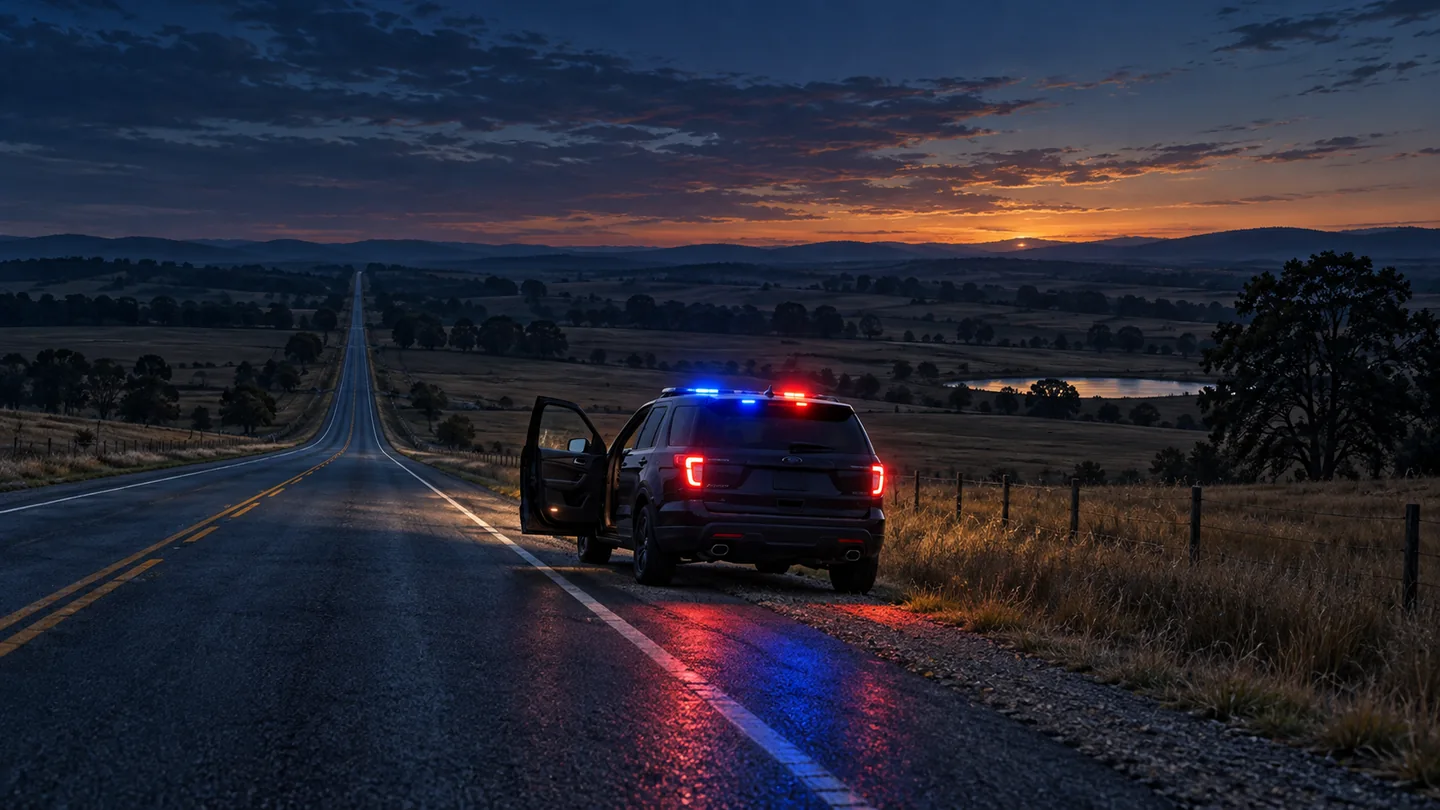
“Officer down” is an urgent call anywhere. In rural America, the miles between an officer and the people coming to help can become part of the emergency.
A quiet road does not promise a quiet encounter. The next call may place one officer in a situation that demands more people than are immediately available. An agency can have committed officers, experienced dispatchers and willing neighbors—and still have a long distance to overcome.
Distance belongs in the conversation about danger.
The Justice Department’s Conversations with Rural Law Enforcement Leaders describes the pressure of limited staffing and resources. One participating chief described officers clearing calls under stress while knowing backup might not be available. A separate Officer Safety and Wellness Group discussion used the example of a rural officer whose backup could be 20 miles away.
Those accounts are not a response-time estimate for every department. They identify a problem that a small population does not make small: the space between needing help and receiving it.
A death count is not the whole story.
The FBI’s Law Enforcement Officers Killed and Assaulted program collects information intended to help agencies understand threats and improve officer safety. Its figures deserve careful reading. Death counts, fatality rates, city population groups and rural jurisdictions describe different things.
We do not need to declare every rural department more dangerous than every urban one to take rural officers seriously. We need to ask what happens in this department, on this shift, when the nearest available help is far away.
Before the call, ask the uncomfortable questions.
For police leaders, this is an invitation to review the real arrangements behind the promise of assistance. Which neighboring agency can respond? What happens when it is busy too? Who knows the communications limitations? How are personnel and their families supported after a frightening incident?
These questions belong with the agency’s operational leaders and its regional partners. A chaplain can help keep the human consequences in view, listen to concerns and connect people with appropriate support. Caring does not replace staffing or an emergency-response plan. It gives people another reason to insist that those plans receive attention.
Small departments need a larger circle of care.
Ask an officer what it feels like to wait for help. Make room for an honest answer. Remember the dispatcher listening, the partner driving toward the call and the family waiting for someone to come home.
Then look beyond a single incident. Is there a trusted person an officer can speak with? Does the department have a relationship with a chaplain before a crisis? If an officer dies, who will help the family while colleagues are grieving too?
The work of preparation includes relationships. A name in a directory becomes useful when someone knows who will answer, what help they can offer and how to reach them.
Build a regional chaplain support plan.
Start with the department’s actual geography and staffing. A useful support plan names people who can be reached, the places they can cover and what happens when the first person is unavailable.
- Make neighboring connections. Meet chaplains and support contacts in adjoining communities. Ask what they can offer and agree how requests should be routed through each agency.
- Arrange backup coverage. Identify another approved contact for nights, leave and overlapping incidents. Confirm availability rather than treating a name in a directory as a promise.
- Account for the miles. Discuss travel distances, communications limitations and safe meeting locations with agency leaders. Agree how a chaplain will be contacted and where to report; do not improvise access to an active scene.
- Include the dispatcher. Make confidential support and follow-up available to the person who heard the call and coordinated help, as well as the officers who responded.
- Stay connected to families. Ask how families want to be contacted and what local support they trust. Plan another conversation after the immediate response, including when the chaplain lives in another county.
This is a plan for human support. It complements the agency’s emergency response, staffing and mutual-aid arrangements; it does not replace them.